
Common Investment Mistakes — And How Beginner Investors Can Avoid Them
Common Investment Mistakes — And How Beginner Investors Can Avoid Them
Common Investment Mistakes — And How Beginner Investors Can Avoid Them
Investing can be one of the most powerful ways to build long-term wealth — but it can also feel intimidating. Many first-time investors worry about losing money, choosing the wrong assets, or entering the market at the wrong time. The truth is, everyone makes mistakes when they start. What separates successful investors from unsuccessful ones is not perfection, but the ability to learn, adjust, and stay disciplined.
In this guide, we’ll break down the most common investment mistakes beginners make — and more importantly, how you can avoid them. By understanding these pitfalls, you’ll be better prepared to build a smarter, more resilient investment strategy.
Mistake #1: Investing Without a Clear Goal
One of the biggest errors beginners make is jumping into investing without knowing why they’re investing. Are you saving for retirement? A home? Financial independence? Short-term gains?
Without a clear goal, decisions often become emotional and inconsistent.
How to avoid it:
- Define your timeline (short-term vs. long-term).
- Decide what the money is for.
- Match your investments to your time horizon.
Long-term goals usually work best with stocks or ETFs, while short-term goals may require safer assets like bonds or savings accounts.
Clear goals create a roadmap — and reduce the temptation to react impulsively.
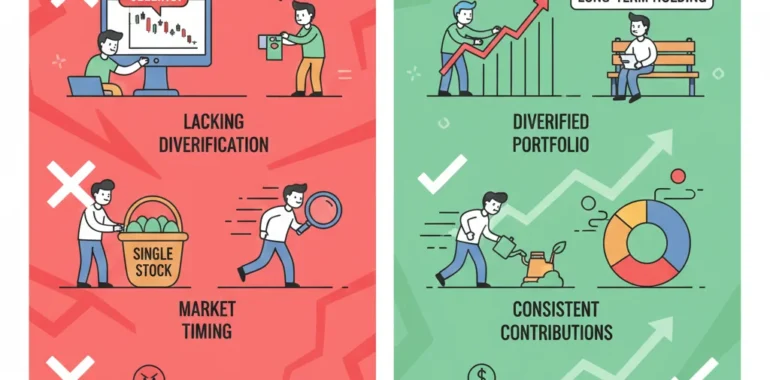
Mistake #2: Trying to Time the Market
Many new investors believe they can “buy at the bottom and sell at the top.” Even professional traders rarely do this consistently. Market timing is risky because nobody can predict short-term market movements with certainty.
How to avoid it: Dollar-cost averaging.
Instead of trying to guess the perfect moment, invest a fixed amount regularly (weekly or monthly). Over time, this averages your purchase price and reduces emotional decision-making. It also keeps you invested — which historically has been one of the strongest strategies for long-term growth.
Mistake #3: Putting All Your Money Into One Investment
Maybe it’s a hot stock everyone is talking about. Or a friend insists a certain crypto will “explode.” Concentrating all your money in one place can be disastrous if that investment performs badly.
Diversification is protection.
Spread your investments across:
- Different asset classes (stocks, bonds, ETFs, crypto, etc.)
- Different industries (technology, healthcare, finance, energy)
- Different regions (U.S., international, emerging markets)
Diversification doesn’t eliminate risk, but it helps reduce the damage if one investment falls.
Mistake #4: Ignoring Fees and Expenses
Fees can quietly eat away at your returns — especially over time. High-fee mutual funds, trading commissions, and hidden management costs can significantly reduce what you earn.
What to watch for:
- Fund expense ratios
- Trading fees
- Advisory or broker fees
- Unnecessary account charges
Where possible, choose low-cost index funds or ETFs, which typically charge much less while still offering strong market exposure.
You may be interested:
Mistake #5: Letting Emotions Control Decisions
Fear and greed are dangerous investing partners. When markets crash, beginners panic and sell. When markets surge, they rush to buy. Both actions often lead to losses.
How to avoid emotional investing:
- Stick to your long-term plan.
- Avoid checking your portfolio obsessively.
- Remember: market drops are normal — and often temporary.
- Focus on data, not headlines.
Successful investors think in decades, not days.
Mistake #6: Chasing “Get-Rich-Quick” Opportunities
Social media, forums, and influencers often promote miracle investments or “secret strategies.” Most of these are hype — or worse, scams.
If something sounds guaranteed, risk-free, or too good to be true… it usually is.
Instead:
- Invest in proven, long-term assets.
- Study companies before buying their stocks.
- Avoid making decisions based only on hype, rumors, or friends’ opinions.
Building wealth takes time, patience, and consistency.
Mistake #7: Not Understanding Risk Tolerance
Everyone reacts differently to risk. Some investors panic during downturns, while others stay calm. If your investments cause constant stress, your strategy may not match your personal risk tolerance.
Ask yourself:
- How would I feel if my portfolio dropped 20% temporarily?
- Would I panic and sell — or stay invested?
- Am I okay with volatility as long as I’m investing long-term?
Choose investments that fit your emotional comfort and financial situation. Remember: the best strategy is one you can stick with.
Mistake #8: Ignoring the Power of Compound Growth
Beginner investors often underestimate how powerful long-term compounding can be. Compounding means your gains start earning more gains — like a snowball rolling downhill.
Even small, regular investments can grow significantly over time.
Example:
Investing $100 per month at an average return of 8% could grow to over $150,000 in 30 years — not because of luck, but because of consistent compounding.
The earlier you start, the more powerful compounding becomes.
Mistake #9: Not Reinvesting Dividends
Some people withdraw dividends rather than reinvesting them. While it may feel like extra income, reinvesting dividends helps accelerate compounding and long-term growth.
Most brokerage platforms allow you to automatically reinvest dividends into additional shares — a simple but powerful strategy.
Mistake #10: Not Continuing to Learn
The financial world changes constantly. New technologies, markets, and investment tools appear all the time. Beginners who stop learning often fall behind, make outdated decisions, or miss better opportunities.
Develop an investor mindset:
- Read financial blogs, books, and articles.
- Follow reliable financial educators (not hype creators).
- Review your strategy at least once per year.
Education is one of the best investments you can make — and it pays dividends forever.
Final Thoughts: Progress Matters More Than Perfection
Every successful investor has made mistakes — probably more than they’d like to admit. What matters most is staying disciplined, asking questions, and thinking long-term.
By avoiding common pitfalls — emotional trading, lack of diversification, chasing hype, ignoring fees, and skipping research — you put yourself ahead of most beginners.
Start small. Stay consistent. Review your strategy. And let time and compounding work in your favor.
Your future self will thank you.