
Day Trading for Beginners: How to Start (and Avoid Big Mistakes)
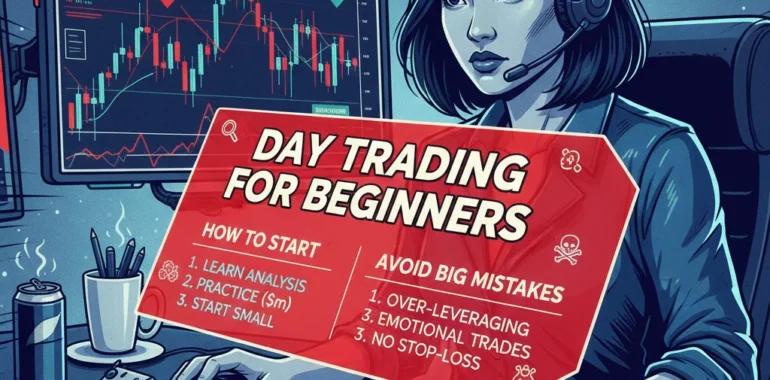
Day Trading for Beginners: How to Start (and Avoid Big Mistakes)
Day Trading for Beginners: How to Start (and Avoid Big Mistakes)
Day trading sounds exciting — buying and selling assets within the same day, catching price movements, and walking away with quick profits. But while day trading can be rewarding, it also carries significant risk. Many beginners lose money not because the market is “rigged,” but because they jump in without a clear plan, discipline, or understanding of how trading truly works.
This beginner’s guide will walk you through what day trading is, how to start safely, and the biggest mistakes to avoid.
What Is Day Trading?
Day trading is the practice of buying and selling financial assets — such as stocks, cryptocurrencies, forex, or commodities — within a single trading day. The goal is to take advantage of short-term price movements, not long-term investments.
Day traders typically look for:
- Small price fluctuations
- Fast trades that last minutes or hours
- Multiple trades per day
Unlike investors, day traders rarely hold positions overnight. Markets can change quickly, and overnight swings can cause unexpected losses.
What Can You Trade as a Day Trader?
Beginner day traders often start with one of the following:
- Stocks – popular and heavily regulated
- Crypto – highly volatile, available 24/7
- Forex – massive global market, high liquidity
- ETFs or indexes – less volatile than individual stocks
It’s better to focus on one market rather than jumping between multiple assets. Each market has its own behavior, trading hours, and risks.
Tools Every Beginner Needs
Before placing your first trade, set up the right tools:
✔ Trading Platform
Examples include TradingView, MetaTrader, Binance, or any broker platform that offers charting tools.
✔ Brokerage Account or Exchange
Choose one that is:
- Regulated
- Low-fee
- Beginner-friendly
- Transparent about risks
✔ Charting Software
This helps you analyze price trends, patterns, and indicators.
✔ Risk-Management Rules
More important than strategy — because it protects your capital.
Recommended for You :
Basic Day Trading Strategies for Beginners
You don’t need dozens of strategies. Start with simple approaches:
1️⃣ Breakout Trading
Traders buy when the price breaks above resistance or sell when it breaks below support.
2️⃣ Trend Following
Trade in the direction of the market trend, not against it.
“The trend is your friend — until it ends.”
3️⃣ Scalping
Very short trades aiming for tiny profits. High-risk if not managed carefully.
Key Technical Indicators to Learn
You don’t need every indicator. Master a few:
- Moving Averages (MA) – identify trends
- Relative Strength Index (RSI) – shows overbought/oversold conditions
- MACD – tracks trend momentum
- Volume – confirms whether price moves are strong or weak
The most successful traders use indicators to confirm decisions, not to replace judgment.
How Much Money Do You Need to Start?
You do not need thousands to practice. Many beginners start with:
- A demo account (no real money)
- Small real trades later
The most important investment is education and practice, not capital.
Risk Management: The Real Secret to Survival
Professional traders talk more about risk than profits.
Follow these simple rules:
- Never risk more than 1–2% of your account per trade
- Always use stop-loss orders
- Avoid revenge trading after a loss
- Don’t trade with borrowed money
If you lose 50% of your account, you need 100% just to break even. Protecting your capital is priority #1.
Common Day Trading Mistakes Beginners Make
Avoid these if you want to last in the markets:
❌ Trading without a plan
❌ Chasing “hot tips” from social media
❌ Over-trading due to excitement
❌ Ignoring fees and commissions
❌ Letting emotions drive decisions
❌ Refusing to accept losses
Every professional trader loses sometimes. The difference is discipline.
Should You Quit Your Job to Day Trade?
No — not at the beginning.
Day trading requires:
- Consistent strategy
- Emotional control
- Experience
- Financial stability
Most beginners should treat day trading as a learning process, not a replacement for stable income.
Final Thoughts: Start Slow, Learn Constantly
Day trading offers opportunity, but it’s not a shortcut to guaranteed wealth. Success comes from preparation, discipline, risk management, and continuous learning.
Take time to:
- Practice on demo accounts
- Develop a trading plan
- Study market psychology
- Accept that losses are part of the process
Use day trading as a way to build skills, not rush results.